Mac Os X Dhcp Server Download Updated
Mac Os X Dhcp Server Download
The 9th major release of Apple'due south server operating organisation is as large a change as the change from Mac Bone X Server 1.0 to Mac OS X Server 10.0. (Readers with longish memories may recollect that Bone X Server had a pre-10.0 version, which was called version 1.0.) In many means, Mac Bone X Panthera leo Server (version 10.7; Mac App Store link) succeeds, but it'southward hampered by UI annoyances and inconsistencies that will probably be fixed in future updates. But correct at present, using Panthera leo Server is a tad more maddening than information technology should be.
Welcome Server.app; good-bye Server Admin—sort of
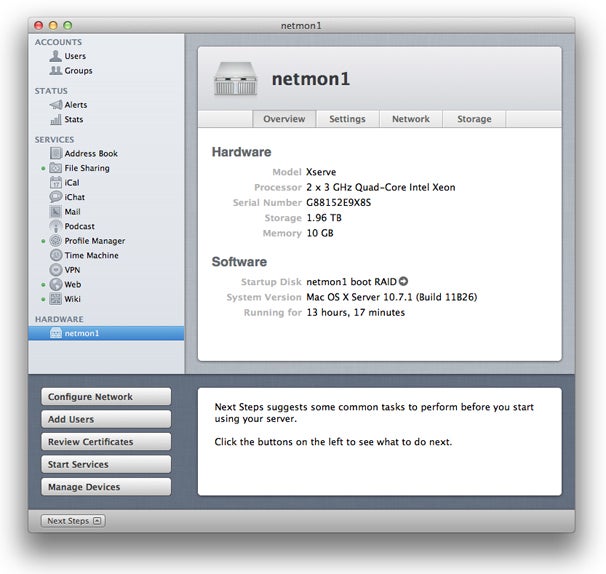
There's a new kid in town for managing King of beasts Server, and it's chosen Server.app. I'g sure that this new server-management program will ane day completely take over all the functions of the familiar Server Admin application, but right now it doesn't, which results in a somewhat boring scrap of hopping back and forth betwixt applications to go things done. For example, Server.app handles Address Book, File Sharing, iCal, iChat, Mail, and other service settings. Server Admin handles DHCP, DNS, NetBoot, Software Update, and others.
The impression is that Server Admin handles what Server.app doesn't—but at that place are instances when you need to use both applications, such as for the Post server and the Podcast server. Server Admin has admission to more settings than Server.app does, so they complement each other. But when both applications manage the same settings, such as host name or SSH enabling, it's really annoying.
Apple did a similar thing to the Workgroup Director application, which was used for user/machine/group/ directory management. In Panthera leo Server, Directory Utility now handles the directory-management tasks. If yous want to edit the LDAP info for Open Directory in a more direct fashion than the regular UI lets you, yous now practise that in Directory Utility. Of course, you can also edit and create users in Server.app. That's convenient.
Why have four applications doing the work of 2? Information technology'due south a petty similar being nibbled to death by baby ducks. It'south certainly not some return-to-Unix idea where each application has a specific focus. Server.app is annihilation merely that. The answer I call up lies in Contour Manager, Apple tree's new tool for managing Macs and iOS devices (more on that after). While yous employ Server.app to gear up Profile Manager, nearly of the actual managing work is done via a Spider web interface. That'south not a bad idea; managing a server is something that, on the GUI level, can be handled quite well via a Spider web UI. (The UI by and large involves picking from a list, entering text, and selecting radio buttons, and checkboxes. Does information technology actually matter if those controls are presented via Cocoa or HTML?)
However, the tools are very much a work in progress. Apple hasn't even come close to a Web UI however—if that is, in fact, the end goal for this. Every bit a event, there are more tools than e'er to manage Lion Server, and given the radical changes Apple has made to those tools (especially in Server.app), it actually makes managing King of beasts Server more piece of work than Mac OS X ten.half-dozen Server ().
Where did the controls go?
The other issue with Server.app is that, for the virtually role, at that place isn't a lot there. For example, unlike Bone Ten 10.6 Server'southward Server Admin utility, which lets y'all do a lot of the configuration tasks for the Web server, Lion Server's Server.app actually doesn't let you do much more than add together sites, specify the ports and the web root directory, and set up some basic admission controls. Annihilation more than that, and you lot're going to have to use and stay with the command line.
In and of itself, this is nothing new. Even though Apple tree provided a GUI for DNS, if you wanted to do annihilation other than the absolute basics, you had to learn the guts of DNS in the command line. For things like SNMP, all the GUI ever did was allow you turn it on. All post-enablement SNMP configuration happens in text files and the command line. In some cases, especially with the Web server, this is a bit of a shock, because the differences in the GUI betwixt versions ten.6 and 10.7 are rather huge. In the instance of iChat server, the differences are rather minor.
The lack of a GUI is upsetting, just in light of what Apple thinks of every bit its main customer base of operations, this makes some sense. For example, if you take the time to look at how Lion Server works and what information technology does with Apache and Web services, it'southward obvious that Apple looks at Apache as a way to get things done. Apache provides the dorsum stop for the Web UI in things like Contour Manager; yous demand information technology for the Wiki service, file sharing for iOS devices, and other services. For Spider web publishing, it's clear that Apple tree wants you lot to employ the Wiki/Blog service built into Panthera leo Server, rather than build sites the traditional way. Apple tree's betoken here seems to be, when it comes to things similar pure Web hosting, at that place'due south not a lot of advantage to using OS X Server. It doesn't provide you with any more capability than yous're going to go off of other platforms like Linux, BSD, or Windows. In fact, if you lot start talking about a lot of Spider web platforms, it's obvious that the but reason Os Ten is mentioned is because it'south based on Unix, and so you lot can utilise Unix tools without a lot of work. But is there some advantage to Os X Server for generic services similar Web hosting? Not really. It'due south great that Panthera leo Server provides this, merely if you wait Apple tree to go after Linux'southward marketplace share every bit an enterprise Spider web hosting platform, you lot might be confusing Apple with some other company.
Another problem with Lion Server is that then footling of this is documented. Apple's server documentation for Lion Server is, to be charitable, thin. Apple tree moved some of the documentation to the Web, but you tin can't get to all of it from the main documentation site. You have to be in Server.app to get to parts of the documentation, such equally the Profile Manager—more specifically, y'all open Server.app and then click on the link to the Profile Managing director Spider web UI (or become to https://serverdnsname/profilemanager), log in, and then, from the drop-downward menu in the upper correct, click on Assist. That will take yous to http://aid.apple.com/profilemanager/mac/10.7/, which is an Apple webpage. If y'all go to http://aid.apple tree.com, yous'll find that nothing about Lion Server exists as a direct link from that page.
This is the issue I have with Lion Server as a whole: even though Apple has made a lot of changes to Os X Server, the whole package is and then evidently a work in progress. Take a simple task like file sharing: Yous go to the File Sharing section to enable sharing, and you tin set some basic permissions, only if you want to ready annihilation beyond read only, write only, or read-write, then y'all have to go to the hardware settings, then storage, then you lot can set more-detailed ACLs. It's a remarkably kludgy system; why not take all the file-sharing settings in one identify, you lot know, under, possibly, the File Sharing section?
For Apple, the state of the server-management GUIs is bad, virtually approaching bloodcurdling. Because of this, the pretty awesome new features in Lion Server aren't as cool as they could exist.
Whither Samba
Prior to King of beasts Server, Os X used Samba, an excellent open up-source projection that allows non-Windows platforms to both admission and serve files every bit a Windows server. Prior to Lion Server, Samba was how OS X Server handled Windows file- and print-serving tasks.
In July of 2007, the Samba group announced that it would be moving to version three of the Free Software Foundation's General Public License. Some aspects of the GPL 3 created bug for Apple, and then rather than go on with a expressionless version of Samba in OS X Server, Apple removed Samba and wrote its ain SMB customer and server for Lion Server. All the SMB support in OS 10 Server from that point on out has come from Apple.
Lion Server provides but basic file sharing. Windows NT Domain support is gone, but Vista works with NT domains only with some tweaking, and Windows seven won't work with NT domains at all, so this is non a huge problem. Microsoft has been running away from NT 4 domains since 2000.
What about impress sharing?
Print sharing is still in Panthera leo Server, but Apple no longer has any kind of custom GUI for it. Instead, yous use the CUPS interface, which is a Web UI at http://localhost:631. You no longer demand a special program to prepare up print sharing, which is an advantage. The downside is that while CUPS has thorough documentation, it'southward non exactly geared toward novices, and without Samba, print sharing to Windows clients is a lot trickier.
If you accept to do a lot of extensive print sharing, consider keeping your impress server at version 10.6, and let Apple tree know you lot actually need improve print serving capabilities to upgrade fully to Lion Server.
MySQL
MySQL is gone, replaced by PostgreSQL. Why? Apple isn't telling. If I had to estimate, I'd say it comes downwardly to licensing. Oracle'south licensing for MySQL is a chip of a mess; the license you're issued depends on the way you utilize MySQL. PostgreSQL is under a BSD license, which is something Apple favors far more.
If you lot already accept MySQL information or binaries, Lion Server doesn't delete them, but Lion Server doesn't provide fifty-fifty the rudimentary controls for MySQL that OS Ten 10.6 Server provided, and if you desire to utilise PostgreSQL, whatever customization you lot want to practise must be done via the command line or third-party tools.
Contour Managing director
Contour Manager is the one shining star in King of beasts Server. Profile Director allows you to finally manage iOS devices from an Apple server Os (what a concept!), and it does and so in a way that is really useful, well thought out, and rather friendly to both IT pros and users.
Going forward, Profile Manager is how Apple wants y'all to manage users, user groups, Macs, groups of Macs, iOS devices, and groups of iOS devices. It'south primarily a Spider web-based implementation with a focus on cocky-service. Users can go to a Web portal (https://serverdnsname/mydevices), log in with their directory credentials, and so add their Mac or iOS device into management. I haven't had a chance to exercise a lot of work with the Mac side of things in Profile Director, but the iOS side works really well.
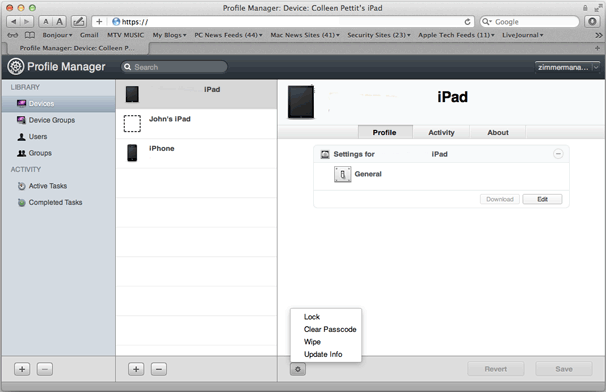
The setup for managing Macs, iOS devices, or both is similar to the iPhone Configuration Utility that Apple tree used to employ as its principal configuration tool for iOS devices. Configuration profiles are distributed as digitally signed XML .mobileconfig files via a number of methods, and information technology works actually well.
With Contour Director, Apple is taking the Mobile Device Management (MDM) concept it first applied for iOS devices and widening the scope to include things you used to do via Workgroup Manager and MCX. This is a benefaction to administrators, especially if you're trying to manage iOS devices and y'all don't want to write your ain setup from scratch, or pay a lot of money to a third party only to manage Apple tree devices. Demand to remote-wipe an iPad? You can do that from Profile Manager. Need to force complex passphrases on your iPhones? You lot can do that from Profile Manager. Even the documentation for Contour Manager, once yous get to it, is solid.
Profile Managing director is an example of just how well Apple can practice things, which is possibly why the condition of the rest of Panthera leo Server's tools and documentation is and so frustrating. When you encounter something done right, it lowers your tolerance for inferior quality, peculiarly when it's inside the aforementioned package.
Be prepared
In Lion Server, Apple has reached farther than it has since version ten.0. With all the changes, every administrator using a previous version of OS X Server needs to think carefully before moving to King of beasts Server. I've migrated a couple of exam servers, and while it wasn't as shine as, say, version 10.5 to ten.six, or even from 10.4 to ten.5, it's not impossible. But you have to program more advisedly than you've had to plan for an Apple tree server version upgrade in the past. I've heard the cries for help from people who decided to upgrade on a whim, and they aren't pretty.
Lion Server has some major bugs, similar a problem with hallmark against OpenLDAP directories, and a serial of issues with Active Directory integration. Moving to Lion Server in these environments is not a great idea right now.
In that location is a lot to like about Lion Server, including its price, Contour Manager, and far improve push support for things similar Post, iCal, and iOS devices. But the good is continuously overshadowed by the fact that you must bounciness between multiple tools and that the documentation is skimpy, if not only poor. And there's always bugs that happen with every major release of the Bone and the server versions.
In time, Lion Server will be solid. However, as reviewed (version 10.7.1), Lion Server needs a lot of piece of work, and I would think very, very carefully before upgrading.
Macworld'due south ownership advice
Different previous versions of Mac OS Ten Server, Lion Server is not a simple upgrade. Regardless of the cost of this server package, the massive changes at every level of Lion Server—including the removal of some features customers rely on—brand this upgrade ane you'll want to recall hard near, regardless of price. The documentation and fit-and-finish problems will too help sway your conclusion on whether to upgrade or not.
Mac Os X Dhcp Server Download
Posted by: dianashough1996.blogspot.com

